Air humidification in HVAC: steam, adiabatic or ultrasonic?
Comparing air humidification options in HVAC — steam, adiabatic, ultrasonic. Capacity calculation, hygiene and how each appears on the h-x diagram.
An air humidifier adds moisture to the air to reach the required relative humidity (typically 40–60% per general comfort/health recommendations; EN 16798-1 gives specific ranges by category and season). The moisture flow rate is set by the difference in humidity ratio: [kg/h], where is the air mass flow rate. (A quantity in kg/h is a water flow rate, not a power — for a steam humidifier the electrical duty in kW is quoted separately.)
Types of humidifier and their physical principles
1. Steam humidifier (isothermal)
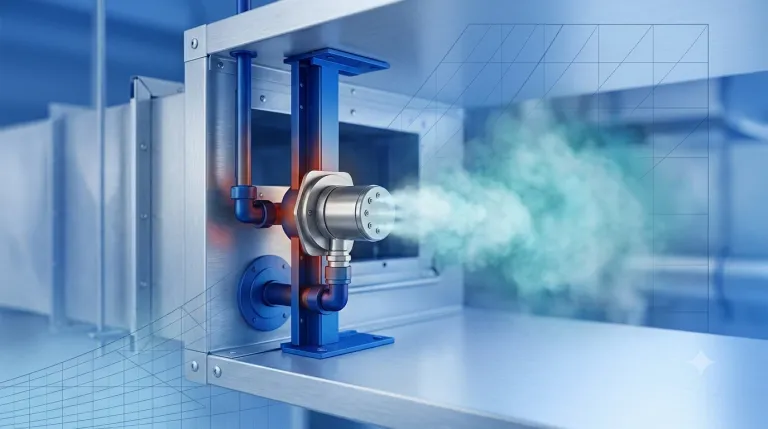
Adds saturated or superheated steam to the air. The steam temperature is higher than the air temperature, which results in a slight rise in air temperature and an increase in humidity.
On the Mollier diagram the process runs almost horizontally ( small, large) — isothermal humidification, more precisely a line to the right and slightly upward.
Steam is the most hygienic option — the high temperature sterilizes the water — and it controls humidity precisely, down to low supply-air temperatures. The price is higher energy use (electric heating or steam from a steam main) and the excess heat output, which has to be compensated for in summer. Types: electrode (current passing through the water), resistive (heating element), gas-fired, or connection to a steam main.
2. Adiabatic humidifier (with air cooling)
Sprays water directly into the flowing air. The enthalpy of the air does not change (an adiabatic process) — sensible heat is converted into the latent heat of evaporation.
On the Mollier diagram the process runs parallel to the enthalpy lines (), diagonally to the right and down.
Air can be adiabatically humidified at most to the wet-bulb temperature () = 100% saturation.
Types of adiabatic humidification:
| Type | Principle | Hygiene risk |
|---|---|---|
| Spray washer (spray) | Spray nozzles, direct contact | Medium (Legionella risk) |
| Wetted-media pad | Air through wetted media | Medium |
| Ultrasonic | Piezo transducer forms an aerosol | Higher (minerals, biofilm) |
| Rotary (evaporative wheel) | Air through a wetted rotor | Lower |
Adiabatic humidification uses no heating energy (only a pump), cools the air at the same time — ideal in summer — and has lower operating costs. The trade-off is hygiene: it carries a Legionella risk unless demineralized water is used, so it needs demineralized water or UV disinfection, and it cannot humidify to 100% (practical efficiency of at most 90–95%).
3. Ultrasonic humidifier
A piezoelectric transducer vibrates the water surface at 1.6–2 MHz and forms microdroplets (a cold mist, Ø 1–5 μm). The airflow carries the droplets away and they evaporate.
Caution: an ultrasonic humidifier also transfers into the air the minerals dissolved in the water (e.g. white dust on the furniture). Demineralized water or UV disinfection is essential. Without water treatment = a hygiene risk.
Calculating the moisture flow rate
Moisture flow rate [kg/h]:
where:
- = air flow rate [m³/h]
- (for 20 °C)
- , = humidity ratio before and after the humidifier [g/kg]
Example: air flow rate 5000 m³/h, inlet: t = 20 °C, φ = 25% (winter state after heating), target: φ = 50%
- g/kg, g/kg, g/kg
- 22.2 kg/h
Which type to choose, and when?
| Situation | Recommendation |
|---|---|
| Hospital, cleanroom, high hygiene | Steam (electrode or resistive) |
| Office, shopping center | Steam or adiabatic (with demineralized water) |
| Industrial hall, large flow rates, summer | Adiabatic (low operating costs) |
| Home, small volume | Ultrasonic (with filtered water) |
| Museum, archive, conservation | Steam (precise control ±3%) |
Standards and hygiene
Per VDI 6022 and EN 16798-3, every humidifier must be cleaned and disinfected regularly. Standing water above 25 °C = optimal conditions for Legionella. Adiabatic systems must pass a microbiological test at commissioning.
Try PsychroView for free
Interactive Mollier diagram directly in the browser. No registration required.
Open app →Or browse example projects to see real HVAC calculations.
Keywords: air humidification, steam humidification, adiabatic humidification, HVAC humidifier, humidifier capacity