Desiccant dehumidification: silica gel, zeolites and desiccant rotors
Desiccant dehumidification with silica gel and rotary dehumidifiers: the principle, the h-x diagram and uses in industry, pharma and storage.
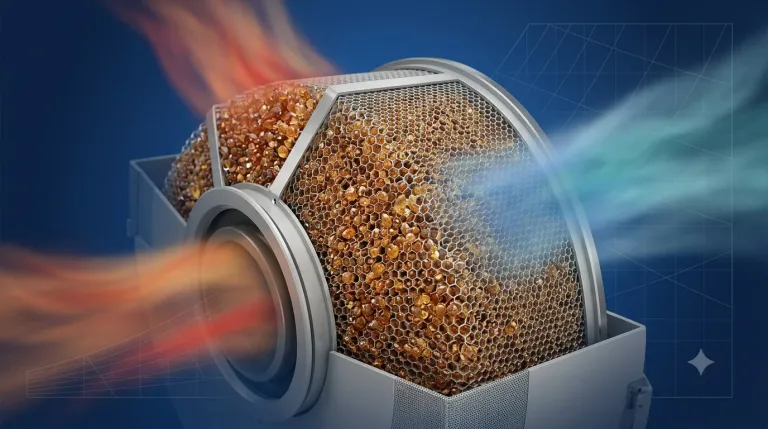
A condensation dehumidifier works well in the range 15–35 °C, but below 15 °C its efficiency drops sharply, and below 5 °C it stops working entirely because the condensate freezes on the evaporator. Yet cold-storage warehouses, drug manufacturing and the drying of compressed air all require very low humidity to be reached. The solution is desiccant dehumidification: a sorbent binds water vapor directly from the passing air, without cooling below the dew point. The resulting dew point can drop to −40 °C or lower.
Adsorption vs. absorption
Both processes remove water, but differently. Absorption is a bulk phenomenon — the water dissolves into a liquid sorbent (lithium chloride, glycols). Adsorption is a surface phenomenon — water molecules bind to the surface of a solid porous material by attractive forces, with no chemical reaction. Adsorption is reversible: heating the sorbent releases the water and the sorbent is regenerated.
Sorption materials
Silica gel
Amorphous silicon dioxide with an enormous internal surface area of up to 800 m² per gram. Its adsorption capacity is 20–40% of its own weight in water, with regeneration at 120–180 °C. The most widespread industrial sorbent, thanks to its availability, non-toxicity and stability; it works best at 30–90% RH.
Zeolites (molecular sieves)
Crystalline aluminosilicates with a precisely defined pore size. They bind water vapor even at very low relative humidity (below 10% RH), where silica gel fails. Regeneration at 200–350 °C. Uses: drying compressed air to a −70 °C dew point, producing technical gases, pharmaceuticals.
Lithium chloride (LiCl)
A highly hygroscopic salt used to impregnate the rotor material in low-temperature applications. At φ < 15% it is more effective than silica gel; its drawback is corrosiveness.
The desiccant rotor: principle and cycle
The most widely used device is the rotary dehumidifier (desiccant rotor). A cylindrical structure filled with sorbent rotates slowly (6–20 rev/h) and alternately passes through two sectors:
- Sorption sector — the humid process air passes through the rotor, the vapor adsorbs onto the sorbent, and the air leaves dry and warmer (sorption is exothermic).
- Regeneration sector — hot regeneration air (80–350 °C depending on the sorbent, lower temperatures for silica gel and LiCl, higher for zeolites) passes through the rotor in the opposite direction, desorbs the water and carries it away.
The rotor turns continuously, part of it always in sorption, part in regeneration, and the result is continuous, near-constant dehumidification.
Plotting the process on the h-x diagram
On the h-x diagram, adsorption runs diagonally to the left and up: the humidity ratio falls, but the temperature rises (exothermic sorption). The outlet temperature of the process air can rise by 10–30 °C. After sorption, an after-cooler is therefore usually needed to bring the air vertically down to the required temperature while keeping its low humidity. The combination of rotor + after-cooler is the standard configuration of an industrial desiccant dehumidifier.
COP and energy use
The effective ratio of output to energy input — a simplified “COP,” though with adsorption it primarily concerns heat for regeneration rather than the mechanical work of a compressor — is markedly lower for a desiccant dehumidifier than the true COP of a condensation one: typically 0.3–0.8 against 1.5–4.0. The higher energy demand is the price for the ability to work at low temperatures and reach extremely low dew points. An advantage can be renewable or waste heat sources for regeneration (industrial exhaust air, solar heat), and the energy balance then turns markedly in favor of the desiccant approach.
Applications in practice
- Pharmaceuticals and biotechnology — drug manufacturing, lyophilization (freeze-drying); dew point −20 to −40 °C, precise control.
- Compressed air — dew points −20 to −70 °C per ISO 8573-1 class; essential in pneumatics, lasers, electronics manufacturing.
- Swimming pools and water parks — at temperatures above 30 °C and high moisture production, desiccant or hybrid systems are more reliable.
- Warehouses and archives — museums, archives, battery stores; long-term maintenance of RH below 30% at variable temperatures.
Frequently asked questions
When to choose a desiccant over a condensation dehumidifier? At low temperatures (below 15 °C) or when a very low dew point is required (below 0 °C), where condensation technology fails or is uneconomical.
Why is the process air warm after the rotor? Adsorption is exothermic — binding the vapor to the sorbent releases heat. That is why an after-cooler is usually placed downstream of the rotor.
How do silica gel and zeolite differ? Silica gel has a high capacity at ordinary humidity (30–90% RH). Thanks to its precise pore size, zeolite binds water even at very low humidity (below 10% RH), which is why it is used for extremely low dew points.
Try PsychroView for free
Interactive Mollier diagram directly in the browser. No registration required.
Open app →Or browse example projects to see real HVAC calculations.
Keywords: desiccant dehumidification, silica gel, desiccant rotor, zeolites, low dew point drying