Relative Humidity: What It Is, Why It Shifts, How to Measure It
What relative humidity is, why it changes with temperature, and how to measure it. Recommended levels for homes, museums and data centers.
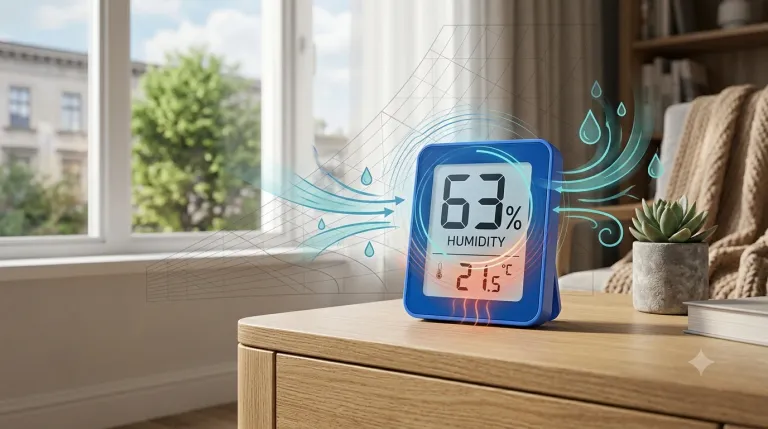
Relative humidity [%] expresses what percentage of saturation with water vapor the air has reached — the ratio of the actual amount of vapor to the maximum possible amount at a given temperature. The number on its own therefore means nothing without knowing the temperature: the same air heated from 23°F to 72°F changes its relative humidity from 85% to roughly 13%, even though not a single drop of water is added or removed. This dependence underlies the entire behavior of moist air.
What relative humidity really tells you
The maximum capacity of air for water vapor depends strongly on temperature — the warmer the air, the more vapor it can hold. That is why outdoor air at 23°F is “humid” (85% RH), yet its actual water content is small. Heat it, and the capacity rises, the actual water content stays the same — and the relative humidity drops sharply.
Example: air at 23°F and 85% RH contains about 14.8 grains of water vapor per pound of dry air. Heated to 72°F, it could hold as much as 119 gr/lb. An actual content of 14.8 gr/lb against a potential of 119 gr/lb gives a relative humidity of roughly 13%. This is why heated indoor spaces have to be actively humidified in winter.
The physics behind relative humidity: saturation vapor pressure
The capacity of air for water vapor is set by the saturation vapor pressure , which rises exponentially with temperature. The exact relationship is described by a family of approximation equations — the most widely used being the Magnus or the Buck equation. For practical purposes it is enough to know that between 32 and 86°F the saturation pressure grows almost sevenfold (and between 50 and 86°F it roughly triples). That is why warmer air has such a markedly higher capacity to hold moisture. You will find the complete formulas in the article Calculating air humidity.
How relative humidity appears on the psychrometric chart
On the psychrometric chart, the lines of constant relative humidity () are curved lines running across the whole chart. The curve is the saturation limit — any air state beyond it produces condensation. Heating the air is a horizontal move to the right: the humidity ratio does not change, but the relative humidity falls, because we move away from the saturation curve.
How to measure relative humidity
Capacitive sensors
The most widespread technology today. A polymer changes its electrical capacitance in proportion to the amount of absorbed moisture. Fast, cheap, easy to miniaturize. The drawback: they drift over time and need calibration. The accuracy of good commercial sensors is usually ±2–3% RH.
Aspirated psychrometer
Two thermometers — a dry one and a wet one (wrapped in a moist wick). Airflow drives evaporation from the wick, which cools it; the relative humidity is computed from the temperature difference and the psychrometric constant. In a good design with sufficient airflow it is still a reference method — the Assmann psychrometer was the meteorological standard for decades. See wet-bulb temperature.
Resistive sensors
A similar principle to capacitive sensors, but the electrical resistance of a humidity-sensitive layer is measured. Cheaper, but less accurate and more prone to contamination.
Chilled-mirror hygrometer
The reference laboratory instrument. A cooled mirror surface detects the moment of condensation and measures the dew point directly, to within ±0.2°F. The price reflects that — these are laboratory-grade instruments, an order of magnitude more expensive than field hygrometers.
What relative humidity is the right one
| Environment | Recommended RH | Note |
|---|---|---|
| Residential buildings | 30–60% | Below 30%, dry mucous membranes and static electricity; above 60%, mold and dust mites |
| Hospitals | 30–60% | Higher humidity encourages contamination |
| Museums and archives | 45–55% (±5%) | Strict stability — fluctuations damage exhibits |
| Data centers (class A1) | 8–80% | Lower humidity = risk of ESD (electrostatic discharge) |
| Pharmaceutical manufacturing | per process (±2%) | Precise control of critical parameters |
The 30–60% RH range for residential spaces is commonly derived from comfort and health recommendations (including ASHRAE Standard 55); no standard sets an exact binding limit for all conditions — it is more of a generally accepted recommended range.
Relative humidity and thermal comfort
The body regulates its temperature partly through sweating — the evaporation of sweat from the skin surface carries heat away. This ability depends on relative humidity: when humidity is high, sweat evaporates with difficulty and heat feels far more unbearable than it would from high temperature alone. Fanger’s PMV–PPD model (the basis of ISO 7730) includes humidity as one of its six comfort parameters. See Thermal comfort and humidity for the details.
Frequently asked questions
Why is a heated home so dry in winter? Cold outdoor air carries little water. Once heated to room temperature its capacity for a higher vapor content rises, but the total water content does not change — the relative humidity often drops below 20%. That is why winter brings dried-out mucous membranes, and why wooden materials work more: beams or wooden furniture can crack, for example.
How often should a home hygrometer be calibrated? Capacitive sensors lose accuracy, so it is worth calibrating them once a year (a saturated-salt test or a comparison against a reference instrument). For industrial applications, use a certified sensor with a calibration certificate.
Does relative humidity tell you everything about the state of the air? No. Relative humidity without knowing the temperature is not enough. The full picture comes from combining both quantities — best shown as a point on the psychrometric chart, from which you can also read the humidity ratio, the enthalpy and the dew point.
Try PsychroView for free
Interactive psychrometric chart directly in the browser. No registration required.
Open app →Or browse example projects to see real HVAC calculations.
Keywords: relative humidity, how to measure humidity, hygrometer, psychrometer, recommended indoor humidity