Wet-Bulb Temperature: Physics, Measurement, and the Psychrometric Chart
What wet-bulb temperature is, how a psychrometer measures it and where to find it on the psychrometric chart. Dew point difference and Sprung equation.
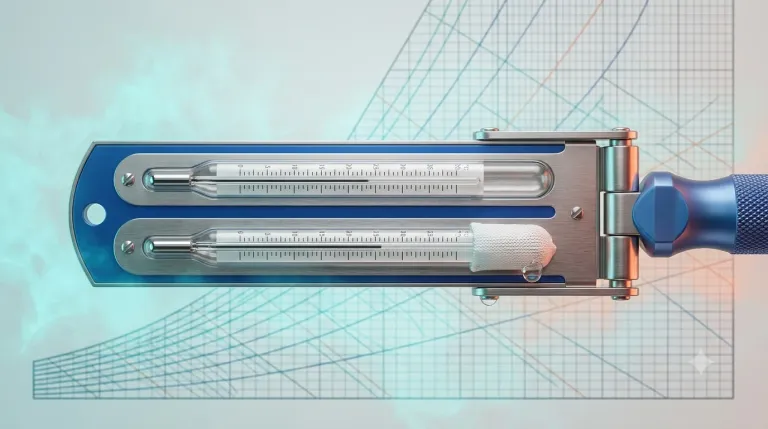
The wet-bulb temperature is the temperature air converges to when water is evaporated into it at constant enthalpy — that is, adiabatically. Physically it is the adiabatic saturation temperature: the point air reaches when brought to saturation without any external energy input. On the psychrometric chart you find it as the intersection of an enthalpy line with the saturation curve. Together with the dry-bulb temperature and the dew point it makes up the three basic temperatures of psychrometrics.
Why the wet bulb cools down
The wick wrapped around the thermometer is soaked with water. Water evaporates from its surface as molecules leave the liquid phase and consume the latent heat of vaporization, which is drawn from the thermometer’s sensor; the sensor therefore cools. At the same time the dry surrounding air brings heat back by convection. Equilibrium sets in when the incoming heat exactly covers the heat needed for evaporation. The temperature at this equilibrium is the wet-bulb temperature.
The equilibrium condition yields the Sprung equation (1888), written for the partial pressure of water vapor. Its coefficient is defined per kelvin, so temperatures go in as °C:
where is the saturation pressure at , is the total pressure, is the psychrometric constant and is the dry-bulb temperature. For an aspirated psychrometer, at a sufficient airflow velocity — that is if you prefer to keep the temperature difference in Fahrenheit degrees. (If you want to express the equation via the humidity ratio instead of pressure, the constant must be multiplied by the molar-mass ratio — substituting directly into the relation for would lead to a substantial error.)
How to measure the wet-bulb temperature
Aspirated (Assmann) psychrometer
A dry and a wet thermometer in tubes through which a fan drives air at a velocity of at least 490 fpm. This velocity is crucial — slower airflow distorts the result. The Assmann psychrometer has been the standard of meteorological stations for over a century and a reference instrument for calibrating hygrometers.
Sling psychrometer
Both thermometers on a rotating arm; the required airflow velocity is reached by swinging it. Its advantage is portability, its disadvantage a larger error from the variable rotation speed.
Electronic substitutes
Capacitive temperature and humidity sensors allow to be computed, since it cannot be measured electronically in any direct way. The calculation runs iteratively using the Sprung equation or psychrometric tables.
Calculating the wet-bulb temperature
There is no direct analytical formula for from and — the equation is implicit. In practice, iterative methods are used. A good approximation is given by Stull’s formula (2011); like Sprung, its coefficients are fitted for degrees Celsius, so convert first. It is valid for and (that is −4 to 122°F), with an average error below 0.5°F — around 2°F in extreme conditions:
For engineering practice it is simpler to read directly off the psychrometric chart.
Where the wet-bulb temperature is on the psychrometric chart
It corresponds to the point where the enthalpy line passing through a given state crosses the saturation curve. For any air state, we move along the line of constant enthalpy — on the Carrier chart that runs up and to the left — until we reach the curve; the temperature at this intersection is . This explains the physics: adiabatic humidification brings the air to exactly this point. On a printed sheet the wet-bulb lines are a family of their own, so is read off directly — see how to read a psychrometric chart, with a blank sheet to print.
Wet-bulb temperature vs. dew point
- Dew point () — the condensation temperature when air is cooled (at constant ). Use it when you want to know the surface temperature at which condensation is a risk: windows, walls, ducts.
- Wet-bulb temperature () — the temperature reached by adiabatic humidification (at constant enthalpy). Use it when modeling evaporative processes: evaporative cooling, drying, heat-stress assessment (WBGT).
Both are always lower than or equal to the dry-bulb temperature. For unsaturated air, ; equality occurs only at , when all three temperatures are identical.
Practical applications
- Evaporative cooling — is the absolute limit of the outlet temperature; the difference gives the maximum achievable cooling.
- Heat stress — the WBGT (Wet Bulb Globe Temperature) index contains as its main component; ISO 7243 (the screening method) and OSHA use it as a criterion for safe work in the heat. For a more detailed analysis, ISO 7933 (the PHS method) is used.
- Drying — in the first phase (constant rate), the surface temperature of the material is approximately equal to the of the drying air.
- Meteorology — from the pair and , all the other psychrometric quantities can be computed.
Frequently asked questions
Why can’t the wet-bulb temperature be measured directly with electronics? Electronic sensors measure temperature and relative humidity. The wet-bulb temperature is derived from them by an implicit equation that the instrument solves numerically — a true “wet” sensor requires a wick and forced airflow.
When to use the dew point and when the wet-bulb temperature? The dew point for questions of surface condensation, the wet-bulb temperature for evaporative processes (evaporative cooling, drying, heat stress).
Why is the wet-bulb temperature always lower than the dry-bulb? Because evaporation from the wick removes heat. Only at 100% relative humidity does the water not evaporate and the two temperatures become equal.
Try PsychroView for free
Interactive psychrometric chart directly in the browser. No registration required.
Open app →Or browse example projects to see real HVAC calculations.
Keywords: wet bulb temperature, psychrometer, adiabatic saturation, wet bulb vs dew point, WBGT